To test formaldehyde levels in your home, you have two routes. A cheap handheld formaldehyde meter or DIY test kit gives a quick reading you can take yourself, but it is easily thrown off by humidity and often measures total VOCs rather than pure formaldehyde, so treat it as indicative only. For an accurate number, book a professional indoor-air-quality (IAQ) test that uses lab-grade sampling, which costs more but tells you where you really stand.
Do home formaldehyde meters actually work?
Sort of. The handheld meters you find online give you a number in seconds, which feels reassuring. The problem is what that number really represents. Many cheap meters report total VOCs (TVOC), not pure formaldehyde (HCHO), so a high reading might be cooking smells, cleaning sprays or fresh paint rather than the formaldehyde you are worried about.
They also drift with the weather. Our humidity and heat in Singapore can skew a budget sensor badly, and the same meter can give you two different readings in the same room an hour apart. Use one as an early warning that something may be off, not as a final verdict.
What can a DIY test kit tell you, and what can't it?
A passive DIY test kit, where you leave a sampler out for a set time and post it back, tends to be more honest than a cheap electronic meter because it targets formaldehyde specifically. It is still a rough guide. The result depends on how long you sampled, how well you sealed the room and the temperature while it ran.
- Good for: a ballpark sense of whether levels seem low, moderate or high.
- Good for: comparing one room against another, like a new-renovation bedroom versus the living room.
- Not good for: a precise figure you can hold a contractor to.
- Not good for: ruling formaldehyde out completely if you have symptoms.
What does professional IAQ testing involve?
A professional indoor-air-quality test is the accurate option. A technician sets up calibrated sampling pumps, draws air over a set period under controlled conditions, then sends the samples to an accredited lab. You get a formaldehyde figure you can actually trust, usually alongside other pollutants.
It costs more and takes a few days for results, but if you are dealing with a fresh renovation, persistent symptoms at home, or a dispute with a contractor, it is worth doing properly rather than guessing from a gadget.
How do I read the numbers?
Whatever method you use, you need something to compare against. The WHO guideline sits around 0.1 mg/m³ (roughly 0.08 ppm) averaged over 30 minutes, and Singapore's SS 554 standard for indoor air quality is similar. We walk through what those figures mean for a home in our guide on the safe formaldehyde level at home.
Bear in mind formaldehyde is classed as an IARC Group 1 carcinogen, so there is no reading you should ignore if it is consistently high. A single spiky reading from a cheap meter is not proof of a problem, but a steady high result from a kit or lab test is worth acting on.
When should I test my home?
Timing matters because composite-wood furniture and panels off-gas formaldehyde for months to years, and heat and humidity speed it up. The most useful moments to test are after a renovation or new furniture delivery, when you move into a recently fitted-out flat, or whenever someone in the home develops unexplained irritation that eases when they are out.
What if my levels come back high?
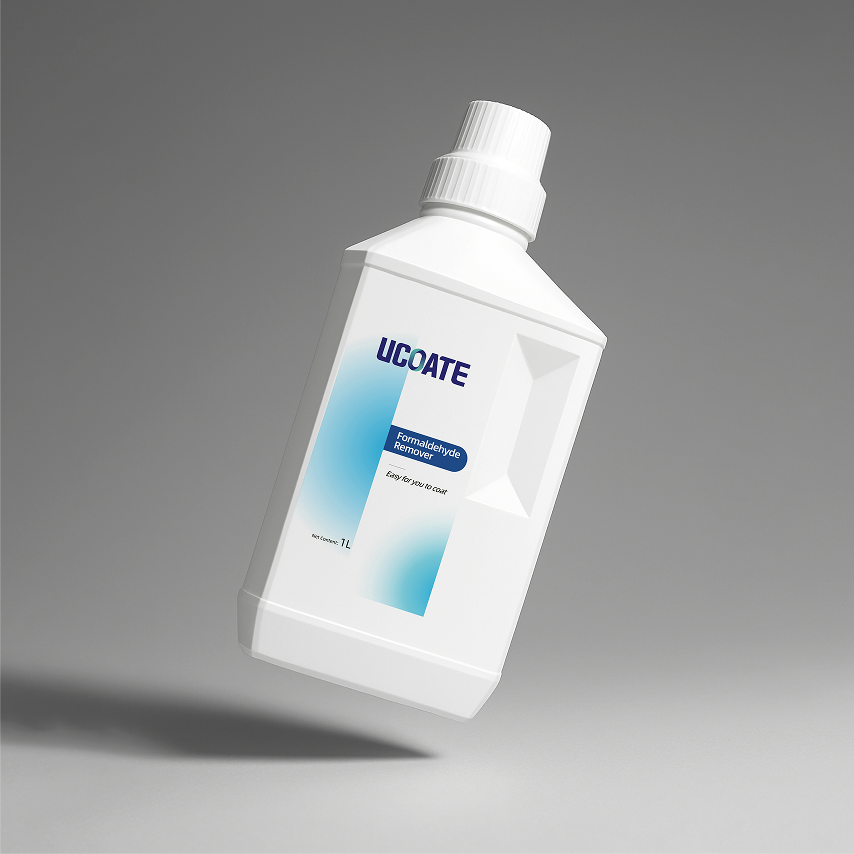
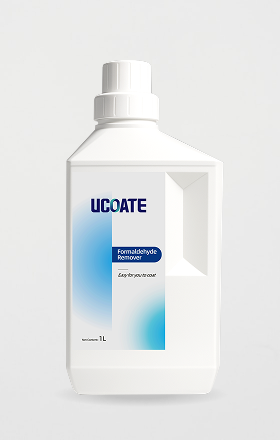
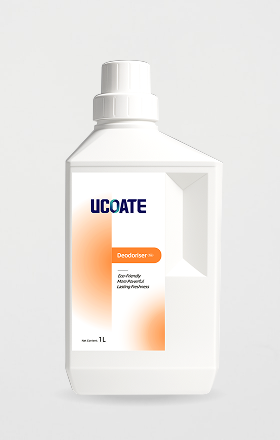
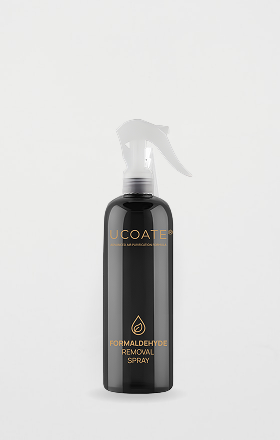
If a test shows high formaldehyde, the fix is to ventilate well and treat the source rather than chase the smell. Open up, run airflow, and tackle the panels and furniture that are releasing the gas. For that last part, the UCOATE Formaldehyde Remover Spray is built for it. It is water-based and non-toxic (OECD 420), safe to use around children and pets as directed, and it binds and breaks formaldehyde down into water and carbon dioxide under normal indoor light. In SGS testing it removed 93.83% of formaldehyde, and a 500ml bottle covers roughly 15 to 20 m². You can pick it up on Shopee. For the wider picture on tackling the source, see our formaldehyde removal guide.
Got a number off your meter and not sure what it means? Our reference tables for HCHO and TVOC readings cover the guideline levels and where each band sits.