
The most widely-used guideline for a safe formaldehyde level in a home is the World Health Organization's figure of roughly 0.1 mg/m3 (about 0.08 ppm), averaged over 30 minutes. Singapore's SS554 indoor-air guideline for air-conditioned buildings sits at a similar level. Staying below that is generally treated as acceptable. But sensitive people can react lower, and because formaldehyde is a known carcinogen, no level is truly "good" — aim as low as you reasonably can.
What is the guideline number?
The WHO's short-term indoor-air guideline for formaldehyde is about 0.1 mg/m3, measured as a 30-minute average. It was set to protect against sensory irritation of the eyes, nose and throat, and it doubles as a level most people won't smell. In Singapore, SS554 (the standard for indoor air quality in air-conditioned buildings) lists a maximum acceptable formaldehyde concentration in the same ballpark, around 0.1 mg/m3. So whether you go by the global figure or the local one, the target is similar.
ppm vs mg/m3: what is the difference?
Cheap home test kits report results in different units, which causes a lot of confusion. Here is the plain-English version:
- ppm means parts per million by volume — how many formaldehyde molecules sit among a million molecules of air.
- mg/m3 means milligrams of formaldehyde per cubic metre of air — a weight-per-volume measure.
- For formaldehyde, the two roughly convert: about 0.08 ppm is close to 0.1 mg/m3. So if your kit reads 0.08 ppm and another reads 0.1 mg/m3, they're saying almost the same thing.
When you compare your reading to a guideline, check you're comparing like with like. A number means nothing until you know its unit. If you're not sure how to get a reliable figure in the first place, see our guide on how to test formaldehyde levels at home.
What does Singapore's SS554 guideline say?
SS554 is Singapore's code of practice for indoor air quality in air-conditioned buildings — offices, malls and similar spaces rather than your flat specifically. It sets a maximum acceptable formaldehyde concentration around 0.1 mg/m3, in line with the WHO figure. It's a guideline for managing building air, not a legal limit for your HDB or condo unit. Still, it's a sensible yardstick to hold your home to, since the air you breathe at home matters just as much as the air at work. For the wider regulatory picture, read our note on the health impacts and regulatory considerations for formaldehyde in Singapore.
What should you do if you're above it?
If a test comes back above the guideline, don't panic, but do act. Most homes that read high are off-gassing from new renovation: fresh plywood, laminate flooring, built-in carpentry, new mattresses or sofas. Two things help most.
- Ventilate. Open windows, run fans and air the place out, especially in Singapore's warmth and humidity, which speed up off-gassing.
- Treat the source. Ventilation lowers the air reading but doesn't stop the material releasing more. Reducing the off-gassing at the surface is what brings levels down for the long term.
If you're also noticing itchy eyes or a scratchy throat, our guide to formaldehyde exposure symptoms at home is worth a read.
Why isn't a "safe" level actually zero?
Formaldehyde is classified by IARC as a Group 1 known human carcinogen, so there's no concentration that's actively good for you. The guideline is a practical line for irritation and short-term exposure, not a promise of safety. Some people — children, the elderly, asthmatics and the chemically sensitive — can react below 0.1 mg/m3. Treat the guideline as "acceptable for most," not "harmless," and keep your home as low as you reasonably can rather than chasing an exact number.
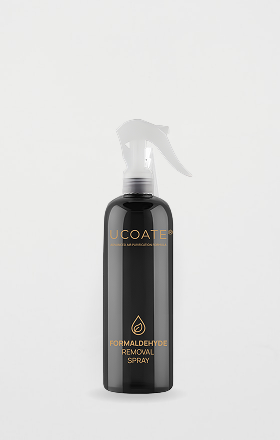
If your reading is above the guideline, ventilate well and tackle the source. A surface treatment like the UCOATE Formaldehyde Remover Spray targets the off-gassing material directly: it's a 500ml water-based, non-toxic formula (OECD 420), safe around kids and pets when used as directed, and it works under normal indoor light, binding formaldehyde and breaking it down into water and CO2. In SGS testing the spray removed 93.83% of formaldehyde. It's available on Shopee. No product gets a home to zero, so think of it as one part of a routine alongside ventilation, not a one-shot fix.
This article is general guidance, not medical advice. If formaldehyde exposure is making you unwell, see a doctor.
Your meter probably shows a TVOC figure next to the formaldehyde one. Here is what both numbers mean, and why they move independently.