Search "formaldehyde remover Singapore" and you get everything from $10 supermarket sprays to professional treatment packages. Most of them make the same promise, and a fair number do almost nothing once the smell fades. If you have just renovated or brought home new furniture, here is how to choose a formaldehyde remover that actually works in a Singapore home, and how to know which format you need.
What a formaldehyde remover has to do
Formaldehyde off-gasses from the adhesives and composite boards in new carpentry for months, sometimes years. A real remover does not cover the smell — it reacts with the formaldehyde and breaks it down so it cannot return. Anything that only masks odour buys you a few days and then you are back where you started.
Four things to check before you buy
- It works without sunlight. The worst off-gassing happens inside closed wardrobes, drawers and cabinets where there is no light. Photocatalyst sprays that need UV barely react there.
- It decomposes, not masks. Look for chemistry that binds formaldehyde and breaks it down — not a fragrance or a short-lived neutraliser.
- It is non-toxic and safe indoors. You are spraying surfaces you live around, so it should be water-based and tested safe for occupied rooms.
- It has local test results. A "low formaldehyde" label is not a test. Ask for independent lab numbers, ideally from a Singapore lab like SGS.
If you want the longer version of this checklist, we wrote a separate guide on how to evaluate a formaldehyde removal product.
A hand spray, or bulk supply?
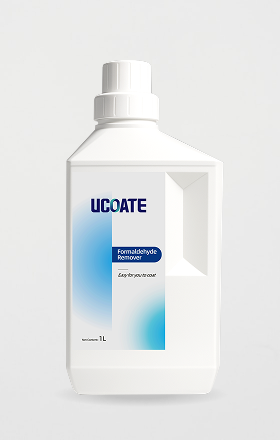
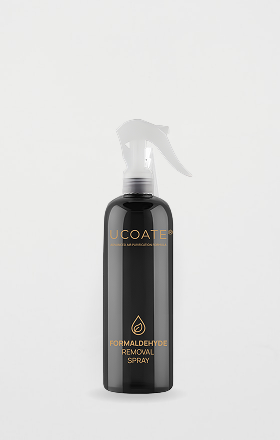
This is the choice most people actually need to make. For a single home — a BTO, a resale flat, a new condo handover — a hand spray you apply yourself is enough. The UCOATE formaldehyde remover spray is a 500ml bottle of the same SGS-tested chemistry we supply to the trade, made for spot-treating new furniture and built-ins at home.
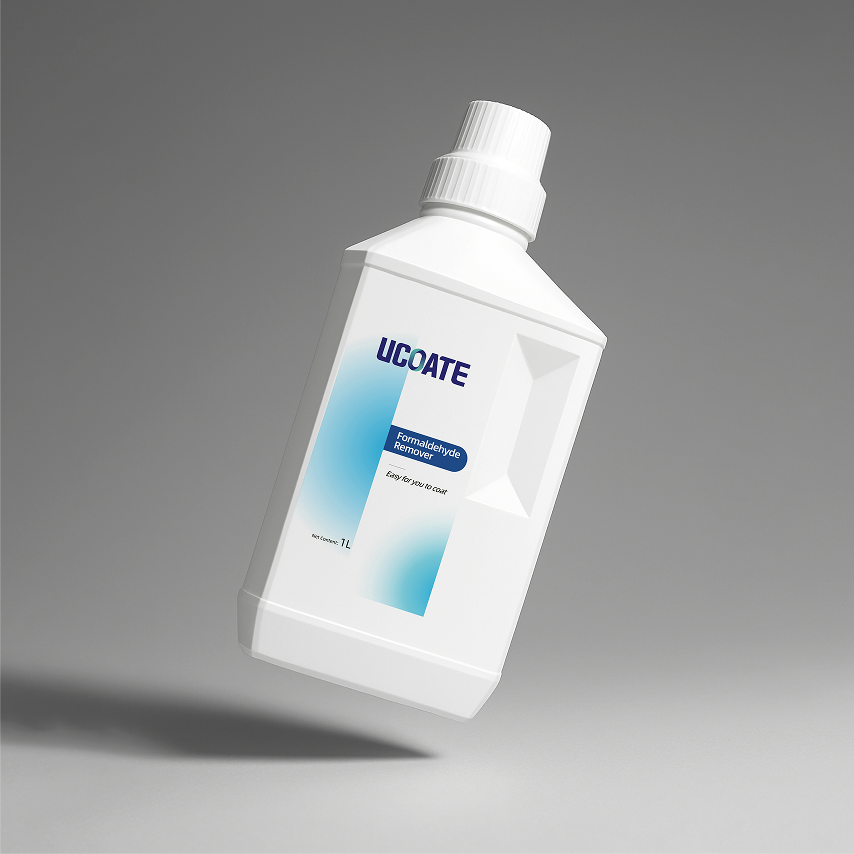
If you are a contractor, applicator or reseller treating whole units or stocking a shelf, you want the bulk formaldehyde remover by the case, with SGS documentation on every order.
What to be wary of
- Cheap chlorine-dioxide or urea sprays. They neutralise a little surface formaldehyde, then the level rebounds within weeks.
- Photocatalyst sprays in dark spaces. They need strong light, so they do little inside the cabinets that off-gas the most.
- Air purifiers sold as a fix. A filter traps some formaldehyde from the air but does nothing to the source. We covered whether an air purifier really helps separately.
Our pick for a Singapore home
For a homeowner doing it themselves, a tested, water-based spray that works in the dark and decomposes formaldehyde rather than masking it. The UCOATE spray removed 93.83% of formaldehyde in SGS laboratory testing and is classified non-toxic under OECD 420, so you can use it in a room you sleep in. You can read the full spec and buy it on Shopee.
Already treated the place and want to know whether it worked? See three ways to tell if your formaldehyde treatment is still doing its job. Buying for a business rather than a home? The trade buyer's guide covers certification, supply and bulk pricing.