
What your HCHO and TVOC readings mean
You bought a meter after the renovation, and now there is a number on it. Here is what HCHO and TVOC actually measure, where the Singapore and WHO guideline levels sit, why cheap sensors mislead — and what to do if your reading is high.
Two numbers, two different problems
HCHO is formaldehyde — one specific compound, mostly off-gassing from the glue in plywood, MDF and particle board. New cabinets, wardrobes, laminate flooring and flat-pack furniture.
TVOC is total volatile organic compounds — everything volatile in the air added together, including formaldehyde but mostly solvent from paint, adhesive, sealant, new textiles and cleaning products.
They move independently, and which one is high tells you where to look. High HCHO with low TVOC points at board and joinery. High TVOC with low HCHO points at paint, glue and solvent.
What your HCHO number means
Readings in mg/m³, with the rough ppm equivalent. Singapore's SS 554 and the WHO 30-minute guideline both sit at 0.1 mg/m³.
| HCHO (mg/m³) | ≈ ppm | Where you are | What to do |
|---|---|---|---|
| Under 0.03 | under 0.024 | Background | Typical of a home with nothing new in it. Nothing to act on. |
| 0.03 – 0.08 | 0.024 – 0.06 | Normal-ish | Common in a Singapore home with some newer furniture. Ventilate, keep an eye on it. |
| 0.08 – 0.10 | 0.06 – 0.08 | At the guideline | The WHO 30-minute guideline and Singapore’s SS 554 both sit at 0.1 mg/m³. You are at the line. |
| 0.10 – 0.30 | 0.08 – 0.24 | Over the guideline | Very common in a freshly renovated or newly furnished unit. Worth treating the source, not just airing it. |
| Over 0.30 | over 0.24 | Well over | Ventilate hard, find what is off-gassing, and treat it. Do not sleep in the room sealed up with the aircon recirculating. |
More detail on the guideline itself: what is a safe formaldehyde level at home.
What your TVOC number means
The five-level scale published by the German Federal Environment Agency (UBA), which is what most consumer meters describe their readings against. Values in mg/m³, based on around eight hours of daily exposure.
| TVOC (mg/m³) | Level | What to do |
|---|---|---|
| Under 0.3 | Level 1 — clean | No action needed. |
| 0.3 – 1.0 | Level 2 — acceptable | Fine for continuous occupancy. Ventilate normally. |
| 1.0 – 3.0 | Level 3 — elevated | Ventilate more, and look for the source. Usually paint, adhesive or something new. |
| 3.0 – 10 | Level 4 — high | Find and remove or treat the source. Do not just run an air purifier at it. |
| Over 10 | Level 5 — unacceptable | Ventilate immediately and limit how long the space is occupied until it comes down. |
Singapore's SS 554 code of practice sets its own indoor TVOC guideline for air-conditioned buildings. If you need the exact figure for a commercial or compliance purpose, work from the standard itself rather than a consumer meter.
Four things about consumer meters
We sell the product that fixes a high reading, so take this as read: the meter is probably less accurate than you think.
Many cheap meters do not measure formaldehyde
A lot of budget units derive the "HCHO" figure from the same general VOC sensor that produces the TVOC number. Spray perfume near one and watch the formaldehyde reading jump. A real electrochemical formaldehyde sensor costs considerably more.
The reading moves with the room
Formaldehyde off-gasses faster when it is warm and humid, which in Singapore means a sealed, un-airconditioned afternoon gives you the worst number of the day. Same room, windows open, reads far lower. Neither is wrong; they are different conditions.
One reading is not a measurement
Take it in the same spot, at the same time of day, with the room closed for a few hours first. A single number tells you almost nothing. A week of them tells you whether it is coming down on its own.
Lab testing is the real answer
If the number matters — a dispute with a contractor, a landlord, or a health concern — a consumer meter is not evidence. Get a proper indoor air quality test done.
How to get a reading worth trusting: testing formaldehyde levels at home.
If the number is high
Ventilation dilutes what is already in the air. It does not stop the surfaces releasing more, which is why the reading climbs again once you close the windows and put the aircon on.
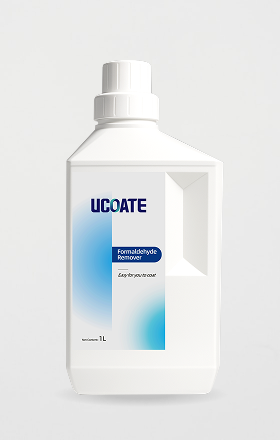
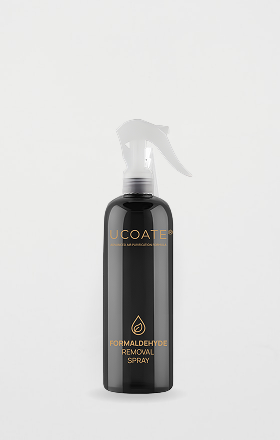
Formaldehyde comes off the surface of new board, joinery and furniture — so that is where to treat it. Our hand spray puts the same SGS-tested chemistry we supply to Singapore contractors into a 500ml bottle for exactly this: new wardrobes, the inside of cabinets and drawers, new beds, and the enclosed spots that off-gas the most.
If the high number is TVOC rather than HCHO, the source is more likely paint, adhesive or sealant — see TVOC and VOC removal.
Common questions about readings
HCHO is the chemical formula for formaldehyde. It is usually shown in mg/m³, sometimes in ppm. In Singapore both the WHO short-term guideline and the SS 554 standard put the reference level at 0.1 mg/m³, which is roughly 0.08 ppm.
Under 0.3 mg/m³ is considered clean, and 0.3–1.0 mg/m³ is acceptable for continuous occupancy, on the five-level scale published by the German Federal Environment Agency. Above 1.0 mg/m³ is elevated and worth tracking down; above 3.0 mg/m³ you should be finding and removing the source rather than ventilating around it.
Most people cannot smell formaldehyde until it is well above the guideline, and some cannot smell it at all. Smell is not a reliable indicator either way — a strong renovation smell is usually solvent and adhesive VOCs, which show up in TVOC rather than HCHO.
The problem is probably not board and joinery. High TVOC with low formaldehyde points at paint, varnish, adhesive, sealant, cleaning products or new soft furnishings. Our TVOC and VOC removal page covers which compounds come from what.
Treat it as a trend indicator, not a measurement. Many budget units calculate the HCHO figure from a general VOC sensor rather than a dedicated formaldehyde one, so alcohol, perfume and cleaning spray will push it up. It is useful for seeing whether a room is getting better or worse over weeks. It is not useful as proof.
Ventilate first — open up and get air moving through. Then deal with the source rather than the air: formaldehyde comes off the surfaces of new board, joinery and furniture, so treating those surfaces is what brings the number down and keeps it there. Our hand spray is made for exactly that on new furniture, cabinets and wardrobes.
Bring the number down
Treat the surfaces that are releasing it. Same SGS-tested formula we have supplied to Singapore contractors since 2018, in a 500ml bottle for the home.