If you want the short version on formaldehyde home remedies: only two things genuinely lower levels at home. Ventilation works, but only while the windows are open. Treating the source is the lasting fix. Activated charcoal and carbon air purifiers help a little until they saturate. Houseplants, bowls of vinegar, boiling water, cut onions and "baking out" the flat with the aircon off are mostly myths. They mask the smell or barely touch it.
That matters in Singapore because most formaldehyde at home comes from the glues in new carpentry and flat-pack furniture, and composite wood keeps off-gassing for months, sometimes years. Heat and humidity speed it up, and shutting the windows to run the aircon traps it. So the question isn't which trick smells nicest. It's which actually removes formaldehyde rather than hiding it.
What actually works
Ventilation. Open windows and run a fan, and you clear whatever formaldehyde is in the air right now. It's free and it works fast. The catch is that it only helps while the windows are open. Close up, switch on the aircon, and levels climb again because the carpentry keeps releasing more. After a fresh renovation, airing the flat out as much as you can is the most useful free thing you can do. Just don't expect it to be permanent.
Treating the source. The off-gassing comes from the boards and glues, so the only lasting fix is to deal with the material itself. Treat the new wardrobes, cabinets and furniture so less formaldehyde keeps coming out in the first place. Do that and ventilation has far less to chase. This is the difference between a flat that smells "new" for two years and one that settles in a few weeks.
What helps a bit (and why it runs out)
A couple of remedies do something real, just not much, and not for long. Activated and bamboo charcoal adsorbs a small amount of formaldehyde onto its surface. The surface is tiny relative to a room, so a few bags saturate within weeks and then sit there doing nothing. Air purifiers with a carbon filter work the same way, capturing some gas as air passes through, until the carbon fills up and needs replacing. Both can take the edge off a small room. Neither touches the source, so the off-gassing continues underneath.
What's mostly a myth (and why)
Most viral home remedies confuse covering a smell with removing a chemical. Houseplants are the famous one. The lab study people quote used sealed chambers and tiny volumes, and you'd need a small forest to shift a real room. Bowls of vinegar, boiling water, cut onions and leftover pineapple, tea or coffee grounds all do the same thing: they add their own scent so your nose stops noticing the formaldehyde. The gas is still there. And "baking out" the flat by shutting it up with the aircon off can temporarily speed off-gassing because heat drives it, but with no ventilation you're just concentrating it indoors, not removing it.
The one fix that lasts: treat the source
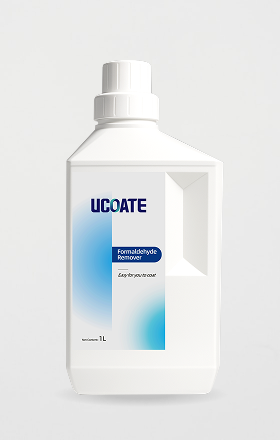
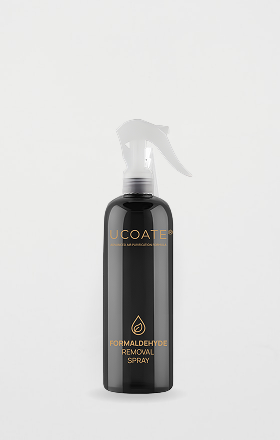
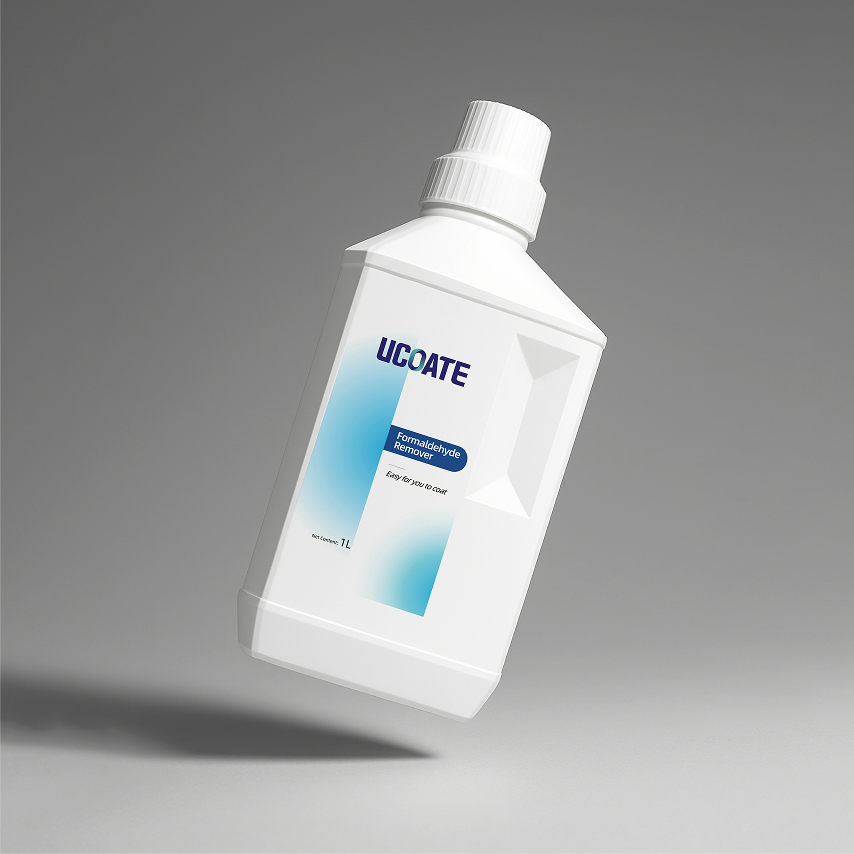
If you only do one thing, treat the carpentry. The DIY way is the UCOATE Formaldehyde Remover Spray. It's water-based and non-toxic (OECD 420 acute oral toxicity), safe around kids and pets when used as directed, and it works under normal indoor light. Rather than masking the smell, the chemistry binds the formaldehyde and breaks it down into water and CO2. In SGS testing it removed 93.83% of formaldehyde. One 500ml bottle covers roughly 15 to 20 m², so you spray new wardrobes, drawers and furniture and let it do the work. It's on Shopee. That's not the only route, but it's the honest version of "treat the source" you can do yourself in an afternoon.
A quick verdict list
- Ventilation: works, but only while windows are open.
- Treating the source: the lasting fix, because it stops the off-gassing.
- Activated/bamboo charcoal: helps a little, saturates in weeks.
- Carbon air purifier: helps a little, filter fills up and needs replacing.
- Houseplants: myth at room scale.
- Vinegar, boiling water, onions, pineapple, tea/coffee grounds: mask the smell, remove nothing.
- "Baking out" with aircon off: traps the gas indoors, doesn't remove it.
For the wider picture, see formaldehyde removal in Singapore, how long off-gassing actually lasts, the practical steps for getting rid of new furniture smell, and a room-by-room plan for DIY formaldehyde removal across HDB and condo layouts. As a rough guide, the WHO suggests keeping indoor formaldehyde around 0.1 mg/m³ (about 0.08 ppm).