It varies, but here's the honest answer: formaldehyde off-gassing is heaviest in roughly the first 3 to 6 months after new carpentry and furniture go in, then it tapers off. The catch is that composite wood like plywood, MDF and laminate can keep releasing formaldehyde for one to three years or more. Singapore's heat and humidity make it release faster, so the peak is sharper, while shut windows and aircon trap it indoors.
What is off-gassing, really?
Most built-in cabinets, wardrobes and flooring in a Singapore home are made from engineered wood. To bind the wood layers together, manufacturers use formaldehyde-based glues. That glue doesn't stay put. Over time it slowly breaks down and releases formaldehyde gas into the air you breathe. That slow release is what people mean by off-gassing.
Formaldehyde is a known human carcinogen (IARC Group 1), so it's worth taking seriously rather than waiting it out blindly. The WHO indoor-air guideline sits at around 0.1 mg/m³ (about 0.08 ppm) averaged over 30 minutes, and Singapore's SS554 uses a similar ~0.1 mg/m³ reference. If you want the fuller picture, our guide to formaldehyde removal in Singapore covers where it comes from and why it matters.
How long does it last — months or years?
Both, depending on what's emitting. Here's a rough sense of the timeline for a typical new fit-out:
- First few weeks: the strongest "new furniture" smell and the highest readings, especially in a closed-up unit.
- 3 to 6 months: the bulk of the off-gassing happens here, then levels start dropping.
- 1 to 3 years: dense composite panels keep releasing low amounts long after the smell fades.
- Beyond that: emissions trail off but rarely hit absolute zero while the material is still there.
The grade and glue used in your boards matters a lot. Lower-emission panels clear faster; cheaper high-emission ones drag on. Our piece on plywood grades and formaldehyde levels explains what to ask your contractor for next time.
Why does Singapore's climate change the timeline?
Heat and humidity speed up the chemical breakdown of the glue, so formaldehyde comes out faster. In one sense that's good — a sharper peak means more of it is released sooner. But our homes work against us. We keep windows shut and run the aircon, which doesn't pull in fresh air. So the gas that's released has nowhere to go and builds up indoors. A new HDB flat, BTO or condo handover sealed up for the aircon can hold higher readings than the same unit aired out daily.
Why doesn't airing out alone ever finish the job?
Ventilation lowers what's in the air right now, which genuinely helps. But it doesn't touch the source. The moment you close up and switch on the aircon, the cabinets keep emitting and levels climb again. Airing out is dilution, not removal. That's also why an air purifier only goes so far — we get into that in does an air purifier help with formaldehyde removal.
How do I speed it up, and when is a room "okay"?
You can shorten the worst of it. Ventilate hard before you move in, open windows daily, and let new furniture air before sealing it inside a cupboard. Running the unit warm with windows open for a few hours can push out more gas, since heat drives emission. Treating the source directly is what shifts the timeline most, rather than waiting on airflow alone.
What counts as "okay" isn't a single date — it depends on the materials, the room and who's living there. A nursery or a home with a baby deserves a stricter bar; see what a safe formaldehyde level at home looks like and our notes on formaldehyde, babies and pregnancy.
A DIY option that treats the source
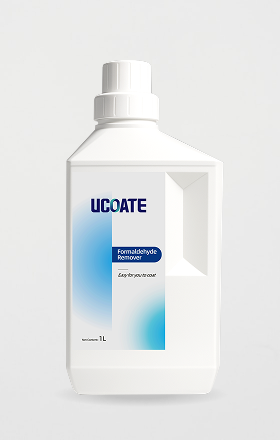
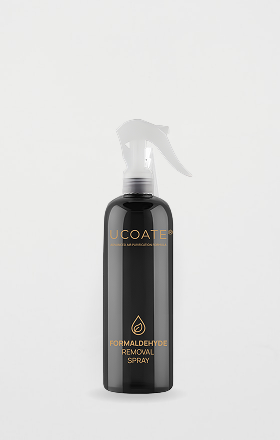
If you'd rather not wait a year for the off-gassing to settle, the UCOATE Formaldehyde Remover Spray is a 500ml water-based hand spray you apply to new carpentry. It binds formaldehyde and breaks it down into water and CO2 rather than masking the odour, and in SGS laboratory testing it removed 93.83% of formaldehyde. It's non-toxic under OECD 420 and safe around children and pets when used as directed, works in normal indoor light, and covers about 15 to 20 m² per bottle. Nothing removes 100%, but treating the source beats airing out alone. It's on Shopee if you want to try it.
Tracking it with a meter? What your HCHO and TVOC readings mean explains how to take a reading worth trusting.