
Formaldehyde decomposition technology
Our water-based formulation breaks formaldehyde and VOCs down instead of soaking them up. Here is how it works, and the independent test results behind it.
Two jobs, one formulation
Advanced odour control
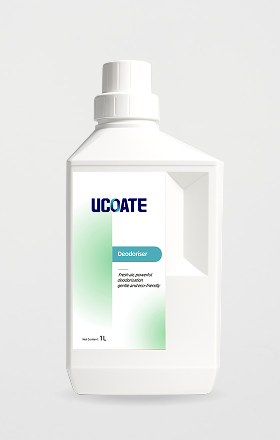
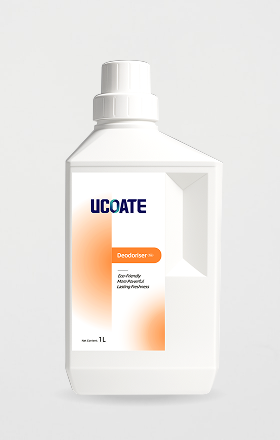
Effectively neutralises VOCs, paint smells and renovation odours, rather than masking them. Tested at over 85% TVOC, 93% benzene and 90% ammonia removal — see TVOC & VOC removal.
Formaldehyde removal
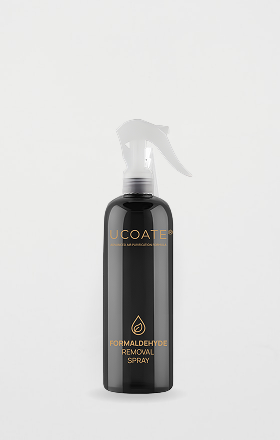
Captures, stabilises and decomposes harmful substances with a scientifically proven, SGS-tested formulation.
How our process removes formaldehyde
It breaks formaldehyde down for good rather than holding onto it — in three steps.

Capture
Positively charged agents actively attract and bind free formaldehyde molecules.

Stabilise
Captured molecules are neutralised and locked into stable compounds through Schiff base formation.

Decompose
A catalytic reaction breaks the stabilised compounds down into harmless water and carbon dioxide.
Built on chitosan and zinc oxide
It uses chitosan and zinc oxide in a water-based solution that is non-toxic and won't corrode surfaces. There is no residue, which is part of why it gets used in places like hospitals, schools and nurseries.
UCOATE vs. other formaldehyde methods
How active decomposition stacks up against activated carbon, air purifiers and UV photocatalyst sprays.
| Activated Carbon | Air Purifier | Photocatalyst (spray) | UCOATE | |
|---|---|---|---|---|
| Working principle | Passive adsorption | Air circulation + filtration | Surface reaction under UV light | Active decomposition without UV |
| Coverage area | Limited to air near the carbon | Works best in a small enclosed space | Only effective under direct light | Entire surface, 24/7 effectiveness |
| Formaldehyde removal | Weak, may quickly reach saturation | Slow, may circulate formaldehyde instead | Requires sunlight, slow process | Efficient capture + breakdown |
| Duration | Needs frequent replacement | Filter replacement every 3–6 months | Coating may degrade quickly | Lasts 6 months–1 year per application |
| Safety & ingredients | May release dust or re-emit VOCs | Safe but limited in effect | May contain titanium dioxide (possible allergen) | Food-grade safe, non-toxic |
| Application method | Passive placement | Plug & play device | UV spray-on, not suitable for all surfaces | Simple spray coating |
| Maintenance | High | Medium | Low | Minimal |
What the testing shows
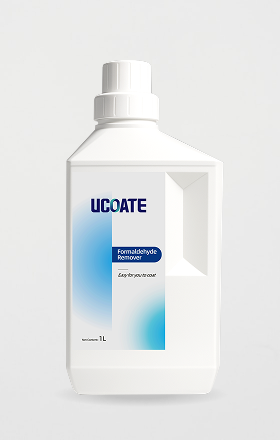
Our Formaldehyde Remover was tested by SGS Singapore and removed 93.83% of formaldehyde. The formulation is tested to EN 717-1 and classified non-toxic under OECD 420.