
Vinegar does not remove formaldehyde in any meaningful way. Leaving open bowls of vinegar around a room, or wiping surfaces with diluted vinegar, won't lower the formaldehyde in your air. The strong vinegar smell only partly masks the chemical odour, and masking is not removing. It also does nothing about the formaldehyde still off-gassing from inside your new carpentry.
Does vinegar remove formaldehyde from the air?
No. There's no good evidence that vinegar lowers airborne formaldehyde to any level that matters. Formaldehyde off-gasses as an invisible gas from glues and resins in new boards, laminate and furniture. A bowl of acetic acid sitting on a table doesn't pull that gas out of the room. What it does is fill the air with a sharp sour smell, which sits on top of the chemical smell and makes it harder to notice. Your nose is fooled, but the formaldehyde reading hasn't changed.
Where does the vinegar tip come from?
Vinegar is one of the most trusted cleaning items in any Singapore kitchen, so it gets recommended for almost everything online. The logic people repeat is that vinegar is acidic and formaldehyde is a chemical, so vinegar must neutralise it. That's a leap. A real chemical reaction needs the right conditions and contact, not a bowl across the room. The advice spreads because it sounds plausible and because, after airing a room, people assume the vinegar did the work the open windows actually did.
Why isn't masking a smell the same as removing it?
This is the part that catches people out. Formaldehyde has a distinct pungent smell at higher levels, so when the smell fades a little, it feels like progress. But a stronger competing odour like vinegar can cover the chemical smell without touching the gas itself. You stop noticing it, which is worse in a way, because you relax while the off-gassing carries on. The same trap applies to scented candles, air fresheners and coffee grounds. They change what you smell, not what you breathe.
Does wiping surfaces with vinegar help?
A little, and only on the surface. Wiping down a new cabinet with diluted vinegar may lift some loose residue or dust, which is fine general cleaning. What it can't do is reach the formaldehyde still releasing from deep inside the board. The gas comes from the resin holding the wood fibres together, not from a film on top. So you clean the surface and feel productive, while the source keeps working underneath. To be fair to vinegar, it's a genuinely useful household cleaner. It just isn't a formaldehyde remover.
What actually lowers formaldehyde at home?
Two things do the real work: airing the place out and treating the source.
- Ventilation — open windows and run fans, especially after new renovation or furniture delivery, to flush the gas outdoors.
- Source treatment — deal with the carpentry and boards that are off-gassing in the first place.
- Heat and humidity awareness — Singapore's warm, humid conditions push off-gassing faster, so fresh renovations need more airing, not less.
We cover the full picture in our guide to formaldehyde home remedies that actually work, and we've looked closely at popular fixes like indoor plants and activated charcoal too.
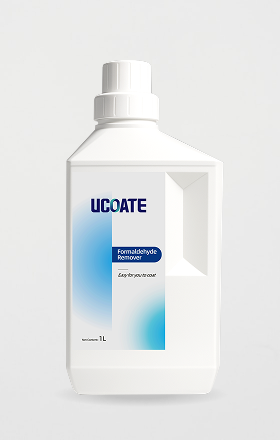
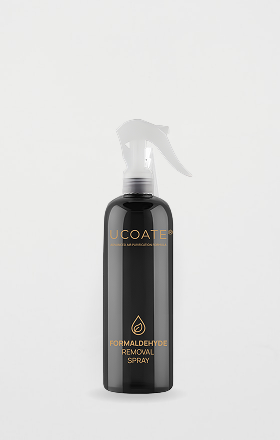
When the source is the problem, you want something that breaks formaldehyde down rather than hides it. The UCOATE Formaldehyde Remover Spray binds formaldehyde and breaks it into water and CO2, so the gas is dealt with instead of masked. It's a 500ml water-based, non-toxic formula (OECD 420), safe around kids and pets when used as directed, works in normal indoor light, and removed 93.83% of formaldehyde in SGS testing. You can pick it up on Shopee, or read more about formaldehyde removal in Singapore.