
Indoor plants do not remove formaldehyde in any amount that matters in a real home. The popular claim traces back to a 1989 NASA test run inside small sealed chambers, not living rooms. In a normally sized, ventilated room you would need an impractical number of plants, far more than anyone keeps, to match what a single open window does in minutes. Keep your plants because you enjoy them, not as an air-cleaning fix.
So do plants remove formaldehyde or not?
A few leaves in a pot will absorb a tiny trace of formaldehyde, which is why lab tests in sealed boxes show a reading. But a home is not a sealed box. Air leaks in and out through doors, windows and gaps, and your furniture keeps off-gassing the whole time. Against that flow, one or two snake plants make no measurable difference to the formaldehyde level you actually breathe.
Where did the houseplant myth come from?
In 1989 NASA published a study looking at whether plants could help clean air on sealed spacecraft. Researchers placed common houseplants inside small, airtight chambers and measured how quickly certain gases, including formaldehyde, dropped. The plants did pull the numbers down inside those tiny boxes, and the result spread fast. Garden centres and wellness blogs have repeated it ever since. The catch is in the setup: a sealed chamber the size of a fish tank behaves nothing like a bedroom with a window and an air-con unit.
Why doesn't it translate to your living room?
The honest problem is scale. When later researchers took the chamber figures and worked out a "clean air delivery rate" for a real room, the numbers fell apart. Studies suggest you would need something like dozens to hundreds of plants in a single room, on the order of 10 to 1,000 plants per square metre, to clear formaldehyde as fast as ordinary ventilation already does. Nobody lives in that. Opening a window or running your ventilation for a few minutes outpaces a whole shelf of greenery.
- Sealed lab chambers concentrate the effect; open rooms dilute it to nothing.
- Composite-wood furniture keeps off-gassing for months to years, so plants face a constant top-up.
- You would need an impractical number of plants to match a single open window.
Which plants always get named?
The same shortlist appears in nearly every viral post: the snake plant (mother-in-law's tongue), spider plant, pothos or money plant, peace lily, and areca palm. They are easy to grow and pleasant to have around, and that is the fair case for them. They add a bit of humidity and lift the mood of a room. What none of them do, in the quantities a person keeps, is meaningfully lower the formaldehyde drifting off new flooring, cabinets or a fresh mattress.
What actually lowers formaldehyde at home?
Two things move the needle: airing the place out and dealing with the source. Formaldehyde mostly comes from composite-wood furniture, glues and laminates, and that off-gassing can last months or years, so good cross-ventilation matters every day, not just on moving-in week. For context, the WHO guideline for formaldehyde sits at roughly 0.1 mg/m³ (about 0.08 ppm). Beyond fresh air, you can treat the surfaces that are giving off the gas. For a wider rundown of the methods people try, see our guide to formaldehyde home remedies that actually work, the question of whether charcoal removes formaldehyde, and how much an air purifier really helps.
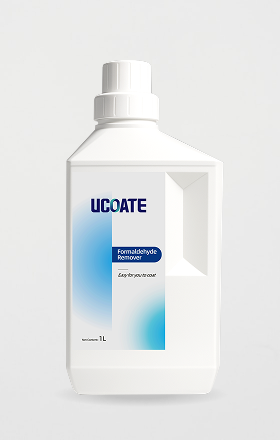
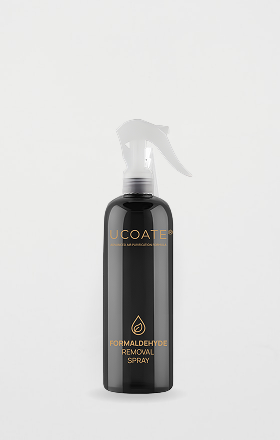
If you want to cut the source rather than wait it out, the UCOATE Formaldehyde Remover Spray is built for that job. It is a 500ml water-based, non-toxic formula (rated under OECD 420) that is safe around children and pets when used as directed. It binds the formaldehyde and breaks it down into water and carbon dioxide, working under normal indoor light with no special lamp needed. In SGS testing it removed 93.83% of formaldehyde, and a bottle covers roughly 15 to 20 m². You can pick it up on Shopee. For more local advice, our formaldehyde removal in Singapore page covers the full picture.