
The pattern is always the same. There's an accident, you clean it thoroughly, the smell goes. Four days later it's back, and on a humid afternoon it's worse than it was originally.
Nothing's gone wrong with your cleaning. The problem is where the residue went.
It's ammonia, and it regenerates
Urine contains urea. Bacteria break urea down and one of the products is ammonia — the sharp smell that hits the back of your throat.
That process doesn't happen once. As long as residue is sitting somewhere with moisture and bacteria, it keeps producing ammonia. So the smell isn't lingering, it's being remade. That's why it comes back on a schedule and why it spikes in humid weather, when there's more moisture available to keep the reaction running.
It also explains the most frustrating version of this: a flat that smells fine most of the time and reeks after a rainy stretch.
Where it actually went
Liquid finds the gaps. On tiled floors it runs into grout lines, which are porous and hold it well. It goes under the edge of skirting, down the joint between skirting and floor, and into the subfloor beneath vinyl or laminate. On soft flooring it goes straight through to the backing and the floor underneath.
Wiping the surface removes the part you can see. The reservoir is a few millimetres down.
If you can't find it by smell, a UV torch in a dark room shows old urine marks clearly. It's a mildly unpleasant exercise and it saves a lot of guessing.
The sequence that works
Find every spot first. Treating three of five doesn't fix anything. Use the UV torch and check along skirting and under furniture.
Use an enzymatic cleaner, generously. Enzymes break down the urea compounds rather than diluting them. The key is volume — it has to soak as deep as the urine did, and a light spray on the surface won't. Let it dwell for as long as the label says, which is usually much longer than people are patient for.
Deal with grout and joints separately. Porous grout may need scrubbing and, in bad cases, raking out and replacing. It holds more than the tile does.
Dry it fully. Moisture left behind keeps the bacteria working. Fans, dehumidifier, patience.
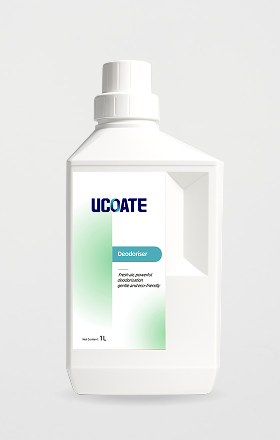
Then neutralise what's left. Even after a proper enzymatic clean, residual ammonia sits in porous surfaces. Our Deodoriser removed over 90% of ammonia in independent laboratory testing, and it neutralises the compound rather than masking it with fragrance. That's the finishing step, not a substitute for the clean.
What doesn't work
Vinegar gets recommended constantly. It has a strong smell of its own that temporarily overwrites the ammonia, and it does very little to the residue. Bicarbonate absorbs some surface moisture and not much else.
Ammonia-based cleaners are worth avoiding specifically — some pets read the smell as a marker and go back to the same spot.
And air fresheners layer floral over ammonia, which is a genuinely awful combination.
If it's a rental or a whole flat
A unit with years of accumulated accidents is a different job from one incident, and at some point soft flooring is cheaper to replace than to rescue. Landlords and cleaning contractors handling this at scale usually work the same sequence with commercial volumes — that's covered on our odour removal page.