
There is no fixed rule for how long to wait after a renovation in Singapore, but the off-gassing from fresh carpentry and new furniture is heaviest in the first few weeks to months, so more time is always better. If you can, air the place out hard for a week or two and treat the new wood at the source before you move in. Most people can't wait that long, so ventilate aggressively and treat the carpentry instead.
Is there a minimum wait after renovation?
No law sets a wait time, and no number suddenly makes a flat "safe". What matters is how much formaldehyde the new materials are still releasing and how well you clear it out. A flat sealed up tight with the aircon on and windows shut will hold that off-gassing in. A flat aired out daily will be in much better shape, even after the same number of weeks.
As a rough guide, two weeks of hard ventilation before you move in helps a lot. A month is better. But the timeline matters less than what you actually do during it.
What's actually off-gassing, and for how long?
The main source is the glue in engineered wood. Plywood, MDF, particleboard and laminate are bonded with formaldehyde-based resins, and they keep releasing it as a gas long after the carpenter packs up. New built-ins, wardrobes, the kitchen carcass and feature walls are usually the biggest contributors in a Singapore flat.
- Off-gassing is strongest when materials are brand new and fades over months to years.
- Singapore's heat and humidity speed it up, so emissions can spike on hot, closed-up afternoons.
- Paint, varnish and adhesives add to it early but usually clear faster than the boards.
For more on the timeline, see our guide on how long formaldehyde off-gasses in Singapore.
What if you have to move in quickly?
Plenty of people get keys and move in within days, especially with a BTO handover or a tight resale timeline. If that's you, the aim is simple: get rid of as much formaldehyde as you can now, and slow down what keeps coming out once you're living there.
Open every window and door and run fans to push air through. Pull out drawers, open wardrobe doors and cabinet shutters so the inside surfaces can breathe. Run the aircon if you must, but crack a window so you're not just recycling the same trapped air. Then treat the carpentry at the source so it releases less over the coming months.
How do you make a new flat safe faster?
Ventilation clears the air you have now, but it doesn't stop the boards from off-gassing tomorrow. That's why the two steps work best together: ventilate to flush what's already out, and treat the wood so less keeps coming.
- Ventilate hard for as long as you can before and after moving in.
- Treat the carpentry with a product that binds and breaks down formaldehyde at the surface.
- Go easy on the aircon-with-windows-shut habit in the early weeks.
Our DIY guide by home type walks through where to focus in a BTO, resale or condo. If you'd rather hand it off, see formaldehyde removal in Singapore.
When should you be extra careful?
Babies, pregnant mums and anyone with asthma or breathing issues should be more cautious about moving into a freshly renovated flat. Their tolerance for irritants is lower, and a newborn spends almost all day at home. If you can give the nursery extra airing time and treat its carpentry first, do that. The WHO suggests keeping indoor formaldehyde around 0.1 mg/m³ (roughly 0.08 ppm) over a 30-minute average, and Singapore's SS554 guidance is similar.
This isn't medical advice. If anyone at home has watery eyes, a sore throat, headaches or breathing trouble that persists, see a doctor. For nursery-specific steps, read formaldehyde, babies and pregnancy in Singapore.
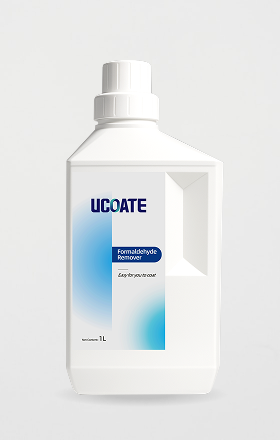
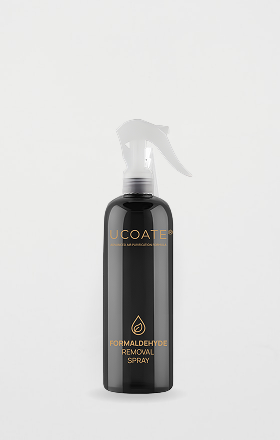
If you want to treat the wood yourself, the UCOATE Formaldehyde Remover Spray is a water-based, non-toxic option (non-toxic under OECD 420) that's safe around children and pets when used as directed. It binds and breaks formaldehyde down into water and CO2 rather than masking the smell, works in normal indoor light, and removed 93.83% of formaldehyde in SGS testing. One 500ml bottle covers roughly 15 to 20 m². It's the same SGS-tested chemistry we've supplied to Singapore contractors and resellers since 2018, and you can pick it up on Shopee.