
Almost all the attention after a Singapore renovation goes to formaldehyde, and reasonably so. But if you've got a meter showing a high TVOC number and a low formaldehyde one, formaldehyde isn't your problem. Solvent is, and benzene is part of that picture.
Where it comes from indoors
Benzene is a solvent. Indoors, it turns up in solvent-based paints and varnishes, adhesives, sealants and caulks, and in some synthetic furnishings and finishes. Anything you've got stored in the flat — thinners, contact adhesive, fuel for something — contributes too. Tobacco smoke is a significant source in its own right.
In a renovation it arrives with the wet trades. Painting, sealing, gluing down flooring. It goes into a sealed, air-conditioned unit and it doesn't have anywhere to go.
Water-based paints and adhesives contain far less of it, which is one of the more useful questions to ask your contractor before the work starts rather than after.
It's in your TVOC, not on its own line
No consumer meter gives you a benzene reading. It doesn't exist as a separate number on a home device — it's rolled into the TVOC total along with toluene, xylene and everything else volatile in the room.
So the practical signal is the pattern rather than a specific figure: TVOC elevated while HCHO sits low points at solvent sources, and benzene sits in that group. If you want the thresholds, they're in our guide to reading HCHO and TVOC numbers.
Getting an actual benzene concentration means a lab test with proper sampling. That's worth doing if there's a real reason — a health concern, a dispute, a commercial space — and overkill otherwise.
It clears differently from formaldehyde
This is the useful distinction, and it cuts in your favour.
Formaldehyde is released slowly from the resin inside pressed board, over years. You can't ventilate your way out of it because the board keeps producing more.
Benzene is solvent, and solvent evaporates. Evaporation finishes. With genuine cross-ventilation — both ends of the flat open, fans running, done for weeks rather than an afternoon — a lot of it goes and stays gone.
Which is why the standard advice to air out a new renovation isn't wrong, it's just incomplete. It works well on the solvent half of the problem and barely touches the formaldehyde half.
Where a formaldehyde product stops
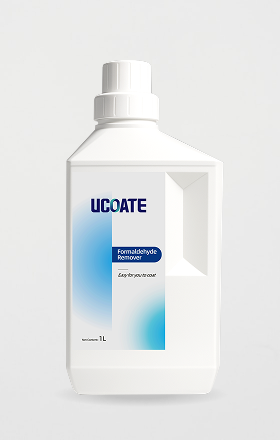
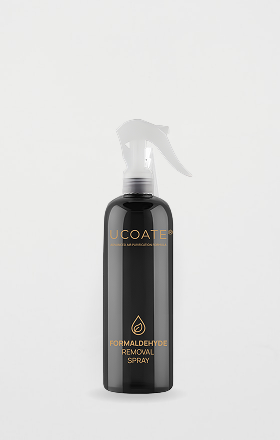
A formaldehyde remover is a targeted product. Ours binds the formaldehyde molecule, locks it into a stable compound and breaks it down into water and carbon dioxide — 93.83% removal in SGS Singapore testing. That works because formaldehyde has a reactive aldehyde group to work on.
Benzene is a stable aromatic ring. Different structure, different chemistry, and a formaldehyde product isn't formulated or tested against it. Anyone telling you one bottle handles both should be asked for the test report.
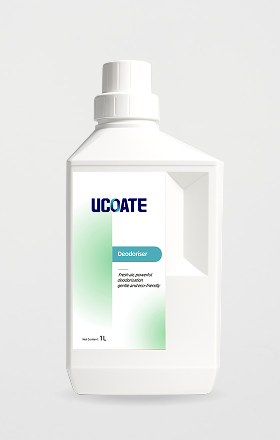
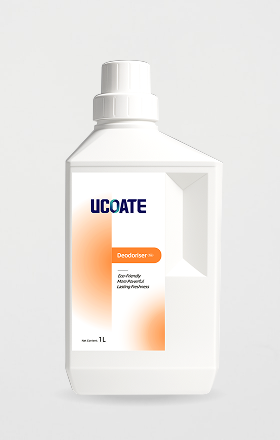
Our Deodoriser is the one tested on this side: over 93% benzene removal, over 90% ammonia and over 85% TVOC in an independent Japanese laboratory report. It's built on plant tannins, amino acids and a carboxymethyl chitosan system rather than the formaldehyde chemistry, and most trade buyers order it alongside the remover for exactly this reason.
What to actually do
Ventilate hard and keep doing it. Weeks, not days. Open both ends, run fans, do it while nobody's home and the aircon is off.
Get solvent out of the flat. Leftover paint, adhesive, thinners in a storeroom keep releasing. Store them elsewhere or dispose of them properly.
Don't smoke indoors. It's the largest indoor benzene source most homes have, and it makes everything else you do pointless.
If it hasn't cleared after a month of proper airing, treat the surfaces. And if you're specifying a renovation, water-based paints and adhesives cost slightly more and save you this entire conversation. More on the full picture: TVOC and VOC removal in Singapore.