
No. A regular aircon does not remove formaldehyde. It cools and dehumidifies by recirculating the air already in the room over a cold coil, so it has no way to break down or trap the gas. Cooling slows off-gassing a little while the room is cold, but the formaldehyde is still there. And because the aircon runs with windows shut, fresh air stops coming in and levels can build up.
Does aircon remove formaldehyde?
It feels like it should, because a cool, dry room is more pleasant and the air smells less stuffy. But comfort is not the same as clean air. A split or window unit moves the same indoor air round and round. Nothing in that loop reacts with formaldehyde or holds onto it, so the gas your new flooring, plywood and furniture release stays in the room.
What does an aircon actually do to the air?
A standard aircon does two jobs, and neither one is air cleaning:
- Cooling: it pulls heat out of the room air as that air passes over the cold coil.
- Dehumidifying: water vapour condenses on the cold coil and drains away, which lowers humidity.
That is it. There is no chemical reaction with formaldehyde and no filter built to capture it. The basic mesh filter inside the unit catches dust and hair, not a gas. Some purifiers and units with activated-carbon or specialist filters are a different story, but even carbon filters saturate over time and then stop adsorbing. An ordinary aircon was never designed for this.
Why can running the aircon make formaldehyde worse?
In Singapore most of us run the aircon with windows and doors shut for hours at a stretch. That seals the room. The formaldehyde coming off your renovation and furniture keeps releasing into a closed space, with no fresh air to carry it out. So the level indoors can climb higher than if you had simply opened up. The aircon is not adding formaldehyde, but it changes how you use the room in a way that traps it.
Does cold air slow off-gassing?
A bit, yes. Off-gassing tends to speed up with heat and humidity, so a cooler, drier room can slow the rate while it stays cold. The catch is that the formaldehyde is not gone, only quieter for now. When the room warms back up after you switch off, the release picks up again. Cooling buys you nothing permanent. For more on timelines, see how long formaldehyde off-gasses in Singapore.
What actually clears formaldehyde?
Two things do the real work: ventilation and treating the source. Open windows and run fans to flush the room when you can, especially in the first weeks after a renovation. Then deal with the materials that are releasing the gas, rather than waiting them out over months or years. People often hope a gadget will fix it on its own, but a quick look at whether an air purifier helps and at which home remedies actually work shows the same pattern: airflow plus source treatment beats any single device.
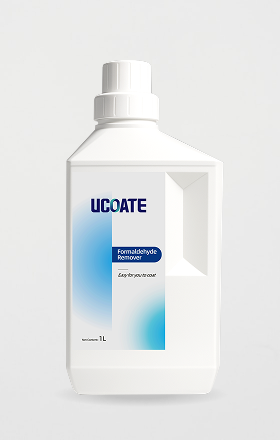
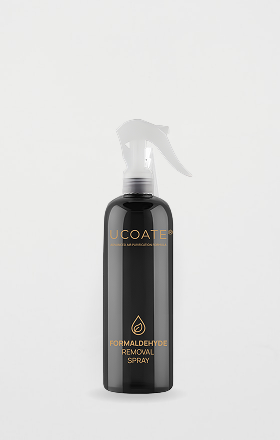
To cut formaldehyde at the source, you treat the surfaces giving it off. The UCOATE Formaldehyde Remover Spray is a 500ml water-based spray that is non-toxic (OECD 420) and safe around children and pets when used as directed. It binds with formaldehyde and breaks it down into water and carbon dioxide under normal indoor light, and removed 93.83% in SGS testing. One bottle covers roughly 15 to 20 m². It is available on Shopee. For the full picture on tackling it at home, read our guide to formaldehyde removal in Singapore.