
You viewed the resale flat, the price was good, and the previous owner smoked indoors for fifteen years. Now it's yours and the smell arrives before you do.
This is one of the harder odour problems in a Singapore home, and most of the standard advice makes it worse by wasting your money in the wrong order.
The smell isn't in the air
That's the thing to get straight first. Cigarette smoke leaves tar and nicotine residue on every surface it touched — walls, ceilings, inside kitchen cabinets, window grilles, the back of built-in wardrobes. That deposit is sticky, it's yellowish, and it keeps slowly releasing the compounds you can smell.
So ventilating clears the air in the room and then the surfaces refill it. Same with an air purifier: it works while it runs and the source is untouched. You can run one for a year in a smoked-in flat and switch it off to exactly the same smell.
Humidity makes it worse, which in Singapore is a permanent condition. Warm damp air lifts more residue off the surfaces, which is why the smell is strongest on a still afternoon in a closed flat.
Why painting straight over it fails
Almost everyone tries this, because it's what a contractor will quote for. A coat of emulsion over nicotine-stained walls does two things: it looks better, and it doesn't stop the smell. Tar residue bleeds through standard emulsion and keeps releasing.
You'll often get a few good weeks while the new paint smell dominates, then the old one comes back through. That's not bad luck, it's the residue doing what residue does.
The order that works
1. Strip out what can't be saved. Curtains, soft flooring, absorbent ceiling material, any old soft furnishings that came with the unit. These hold more than you can realistically wash out and they'll undo everything else.
2. Wash every hard surface. Walls, ceilings, inside every cabinet and wardrobe, window frames, grilles, skirting. A degreasing cleaner, and expect the water to come off brown. This is the step people skip and it's the one that matters most.
3. Seal, if it's heavy. For a badly affected flat, a stain-blocking primer before painting stops the residual bleed-through. Skip this on a lightly affected unit; don't skip it on a fifteen-year one.
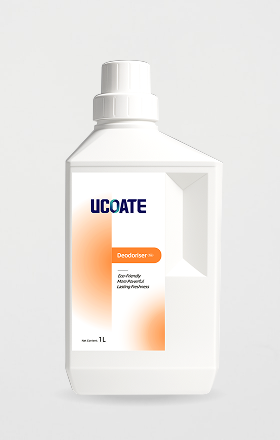
4. Treat the surfaces. After cleaning, there's residual odour in porous materials that washing didn't reach — inside carpentry, in wall finishes. This is what a surface deodoriser is for. Our Deodoriser PRO neutralises the VOCs producing the smell rather than covering them, and it's formulated for exactly these surfaces: painted walls, coated furniture, laminate, wallpaper, leather and synthetic fabrics.
5. Then paint. Not before. Painting first means doing it twice.
Don't forget the aircon
Years of indoor smoking leaves residue through the fan coil units and the ductwork. You can do everything above perfectly and then blow the smell back into a clean flat the first time you switch on the aircon. Get the units chemically cleaned as part of the job, not as an afterthought.
A note on fragrance
Scented sprays, plug-ins and gel tubs are the reflex, and they're the least useful thing you can do. They add a smell on top of a smell. The combination — floral over stale smoke — is usually worse than the original and it fools nobody who walks in.
Deal with the residue. Then, if anything lingers, treat the surfaces properly. More on how odour treatment works: commercial odour removal in Singapore.