
Generally, yes. Like most flat-pack furniture, IKEA pieces use particleboard and MDF that can off-gas a little formaldehyde when new. IKEA sets strict emission limits for its suppliers, so levels are typically low and within accepted standards. A new piece can still smell at first, especially in a hot, closed Singapore room. That's normal off-gassing, and airing it out clears most of it.
Is IKEA furniture safe?
IKEA is hugely popular here, and you'll find its wardrobes, beds and shelving in BTOs and condos all over the island. The boards behind that flat-pack convenience are engineered wood, and engineered wood uses resin glues that contain formaldehyde. So the honest answer is that IKEA furniture is generally considered safe and standards-compliant. It isn't a special case, and it isn't more risky than other mainstream brands using the same materials.
What matters most is how a piece behaves when it's brand new. A fresh board gives off the most formaldehyde in its early weeks, then tails off. That's true of nearly every flat-pack brand, not just one.
Why does flat-pack furniture off-gas formaldehyde?
Particleboard, MDF and fibreboard are made by pressing wood fibres or chips together with a resin binder. Many of those resins are formaldehyde-based, because they're cheap, strong and set quickly. The trade-off is that a small amount of formaldehyde can release from the board over time. Heat and humidity speed that release up, which is why a closed-up flat in the Singapore afternoon can smell stronger than a cooler, ventilated room.
- Particleboard: common in budget cabinets and shelving units.
- MDF: smooth and dense, used for painted fronts and drawer parts.
- Plywood: emissions vary by grade and glue, which we cover in our guide to plywood grades and formaldehyde levels.
How strict are IKEA's formaldehyde limits?
IKEA is well known for setting tight formaldehyde rules for its suppliers. Its requirements are generally at or below international standards such as E1, which is the widely used limit for low-emission boards. In practice that means the boards in IKEA furniture are made to keep emissions low and within accepted limits. That doesn't make any new piece odourless on day one, but it does mean the material was built to a controlled standard rather than left to chance.
Why does my new piece still smell?
A noticeable smell from new flat-pack furniture is normal, and it isn't a sign that something is wrong. The board has been sealed in flat-pack packaging, sometimes for months, so any off-gassing builds up inside the wrapping. When you open it, that trapped smell comes out at once. Drawers and closed cabinets hold it the longest because there's little airflow inside them.
Most of that smell fades with airing. How long depends on the piece, the room and the weather, which we break down in how long formaldehyde off-gasses in Singapore.
How do I get rid of the smell from new flat-pack furniture?
Airing is the simplest fix and it works. Assemble the piece, open every drawer and door, and let air move through the room. A fan and open windows help, and a few days to a couple of weeks usually clears the worst of it. Our full routine is in how to get rid of new furniture smell.
- Unpack and assemble in a ventilated space, not a sealed bedroom.
- Leave drawers and cabinet doors open for the first week or two.
- Run a fan and open windows when the weather allows.
- Wipe surfaces down to remove dust and packaging residue.
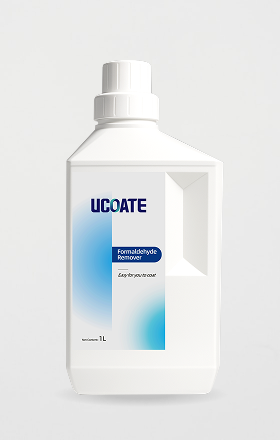
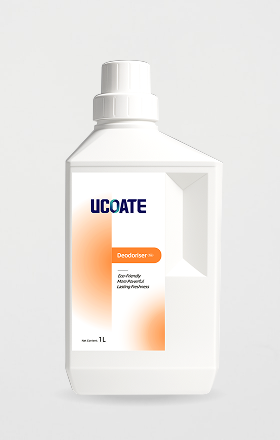
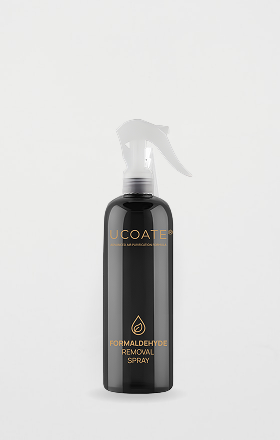
If you want to cut the smell faster, especially inside drawers and cabinets where air can't reach, you can treat the surfaces with the UCOATE Formaldehyde Remover Spray. It's water-based and non-toxic (tested to OECD 420), removed 93.83% of formaldehyde in SGS testing, and binds and breaks the gas down into water and CO2. There's a step-by-step in how to use it on new furniture, and it's available on Shopee. This is an option, not a must. Airing alone works fine for most people.