Laminate flooring usually does contain formaldehyde. Its fibreboard core is bonded with formaldehyde-based resins, so new laminate can off-gas formaldehyde once it is laid. Vinyl and SPC flooring tend to emit less, though their adhesives can still release a little. Reputable products meet emission limits like E1 or CARB Phase 2, which keep levels low. New flooring off-gasses most when fresh and eases over time.
Does laminate flooring have formaldehyde?
Most laminate is built on a high-density fibreboard (HDF) core. That core is wood fibre pressed together with resins, and those resins are often formaldehyde-based. The chemistry is what gives laminate its strength and moisture resistance, so the trade-off is some formaldehyde locked into the board. When the flooring is new, a small amount of that formaldehyde escapes as gas into the room. This is normal and it slows down as the months pass, but it is the main reason laminate gets singled out in conversations about indoor air quality.
What about vinyl, SPC and engineered wood?
Vinyl and SPC (stone plastic composite) planks are popular in HDB and condo renovations because they handle Singapore's humidity well. They generally emit less formaldehyde than laminate, since the plank body is plastic and mineral rather than resin-bonded wood. The adhesives and backing can still release small amounts, so it is not always zero. Engineered wood sits in the middle: it has a real timber top layer over a plywood or HDF base, and the glues in that base may emit a little. The honest summary:
- Laminate — fibreboard core, most likely to off-gas formaldehyde.
- Engineered wood — plywood/HDF base with adhesives that may emit some.
- Vinyl / SPC — usually lower-emitting, though glues and underlay still count.
No flooring type is automatically unsafe, and no single brand is automatically a problem. It comes down to how the product is made and what limits it is certified to. For the wider picture on resin-bonded boards, see our guide to plywood grades and formaldehyde levels.
How do you spot low-emission flooring (E1, CARB labels)?
Look for an emission rating before you commit. The two you will see most often are the European E1 grade and California's CARB Phase 2 standard. Both cap how much formaldehyde a board is allowed to release, so a product carrying them has been tested against a limit rather than left unmeasured. Ask the retailer for the specification sheet, not just a verbal assurance. If a supplier cannot show you any emission label, that is a fair reason to ask more questions or look elsewhere.
How long does new flooring off-gas?
Most off-gassing happens in the first weeks after the floor goes down, then tapers off over the following months. Heat and humidity speed it up, which matters here because Singapore homes run warm. The adhesive used to fix the planks and the condition of the subfloor underneath also feed into the total, not just the planks themselves. For a fuller timeline, read how long formaldehyde off-gasses and what counts as a safe formaldehyde level at home.
How do you reduce it at home?
Ventilation does most of the work. Open windows, run fans, and air out a freshly renovated unit before you move in or sleep in it. Warmth and airflow together help the flooring release and clear faster. Keep in mind that flooring is rarely the biggest source in a new reno; built-in carpentry and cabinets usually carry more formaldehyde because of the engineered boards they are made from.
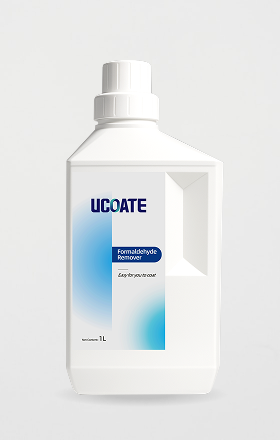
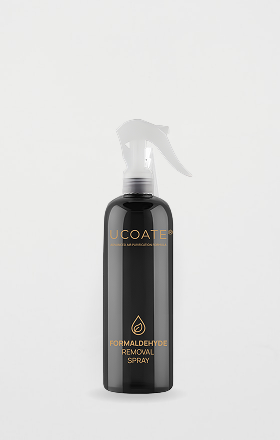
Ventilation plus treating the bigger sources, your new carpentry and cabinets, is the main job. For compatible surfaces you can also use the UCOATE Formaldehyde Remover Spray, a 500ml water-based, non-toxic spray (OECD 420) that removed 93.83% of formaldehyde in SGS testing and is available on Shopee. It suits cabinetry and carpentry best. For flooring, only treat finishes that are compatible: test a hidden spot first and avoid water-sensitive or discolouration-prone surfaces. For the broader approach, see our overview of formaldehyde removal in Singapore.