New cupboards in, and there's a sharp chemical smell every time you open the doors? That's usually formaldehyde. It comes out of the glue and composite board (plywood, MDF, particle board) that most built-in carpentry in Singapore is made from, and a closed cupboard traps it.
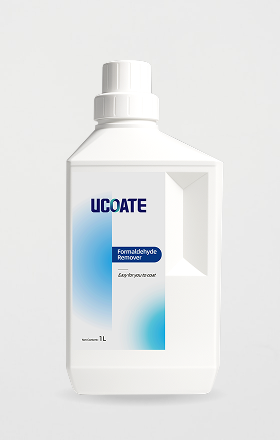
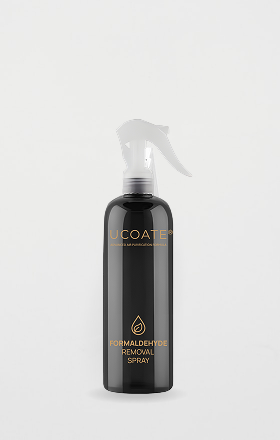
A lot of people go looking for a DIY formaldehyde removal spray to fix it. Some of those sprays work. Many of the cheap ones don't. Below is how to tell them apart and how to treat a cupboard properly. If you just want the one we make, it's the UCOATE formaldehyde removal spray, a 500ml bottle you can buy on Shopee.
Why most cheap DIY sprays don't work
Marketplaces are full of "formaldehyde removal sprays" at $10–$20. Most of them mask the smell for a few days and leave the formaldehyde where it was.
1. Low-cost chemical ingredients
Many low-priced sprays use chlorine dioxide, hydrazide compounds or urea derivatives. These can neutralise a little of the formaldehyde sitting on the surface, but:
- They don't reach into the board, which is where most of the formaldehyde comes from.
- Some of them irritate skin, eyes or throat.
- The effect fades quickly.
2. Photocatalyst sprays need strong light
Pricier photocatalyst sprays use titanium dioxide (TiO₂). It does break formaldehyde down, but only under strong UV or visible light. The inside of a cupboard is dark, so the reaction barely happens there.
What actually works
1. Ventilation
Moving air is still the safest way to bring formaldehyde levels down. Open the windows, run a fan and leave the cupboard doors open so the board can off-gas. It's slow, though. New carpentry off-gasses hardest in the first 3 to 6 months and can keep going for a year or more, as our guide to how long formaldehyde off-gasses explains.
2. A lab-tested spray, used properly
If you'd rather treat the cupboards than wait it out, pick a spray with third-party test results you can actually read.
Ours is the UCOATE Formaldehyde Remover Spray, developed in Singapore. In SGS testing the formula removed 93.83% of formaldehyde, and it's classified non-toxic (LD₅₀ > 2000 mg/kg·bw). It's made with chitosan, zinc oxide and catalytic additives for use on cupboards, furniture and walls, and it doesn't need light to work. Many professional cleaning and air-treatment companies in Singapore use UCOATE to treat new furniture and renovated spaces.
How to treat new cupboards with a spray
- Empty the cupboard, open the doors and drawers, and wipe the surfaces clean and dry.
- Shake the bottle well. Spray a light, even mist from 20–30 cm away without soaking the board.
- Do the insides: shelves, back panels, the backs of doors and the drawer boxes.
- Leave everything open while it dries. It's touch-dry in about 30 minutes.
- If the smell is strong, give it a second coat after 30 minutes.
- Don't wipe or clean the surfaces for 3–5 days while it cures.
Doing a whole room of new furniture? Our guide to spraying new furniture covers the spots people usually miss.
So, is a DIY spray worth it?
A cheap spray mostly buys you a better smell for a week. A tested one, sprayed inside the cupboards and backed up with fresh air, deals with the formaldehyde itself. For your next round of carpentry, ask for E0 or E1 grade board, and keep the windows open for the first few months.
Where to buy
The 500ml spray is on Shopee, with delivery across Singapore. One bottle covers over 50 m², roughly two full-height wardrobes. Treating a whole unit for clients, or buying for a business? Ask us for trade pricing.
If you want the chemistry rather than the how-to, our technology page walks through how the capture-stabilise-decompose process works.