
Any operator who's run an F&B unit for a few years knows this one. The kitchen gets degreased on schedule, the surfaces are genuinely clean, and the back-of-house still smells like eight months of service.
Two different problems get conflated here, and only one of them comes off with a cloth.
The deposit and the odour are separate
Cooking puts aerosolised fat and volatile compounds into the air. The fat lands on surfaces as a film — that's the deposit, and degreasing removes it. Straightforward, and if you're not doing it you have bigger problems than smell.
The volatile compounds behave differently. They absorb into anything porous within reach: plaster, painted surfaces, sealant, ceiling tiles, grout, soft seating and any timber in the space. Then they release again, slowly, for as long as they're in there.
So a spotless kitchen that smells isn't a cleaning failure. You cleaned the surfaces. The smell is coming from inside them.
Sort the ventilation before anything else
Treating a space while the source keeps loading it is money spent on a rolling basis.
Check that the extraction is actually moving what it's rated to move — filters clogged, ductwork loaded, fans past their best. Check the makeup air, because an extraction system with nowhere to draw from underperforms badly.
And check the pressure relationship between kitchen and dining room. If the dining area is negative relative to the kitchen, you're pulling kitchen air into the room where customers sit. That's a design problem no amount of treatment solves, and it's more common than operators expect.
Then treat what's absorbed
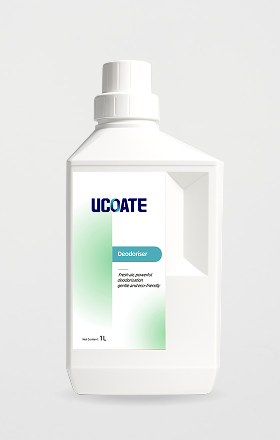
Once extraction is doing its job and the surfaces are degreased, what's left is the absorbed load. That's what a surface deodoriser is for.
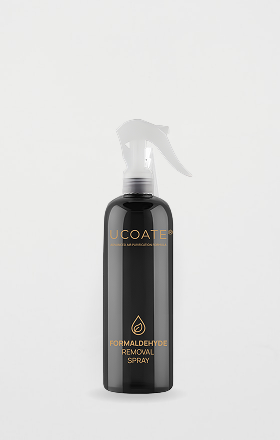
Our Deodoriser PRO neutralises the VOCs producing the odour rather than adding fragrance over them. It covers roughly 60–80 m² per litre, which matters when you're treating walls and ceilings across a back-of-house rather than a domestic room, and it's formulated for painted walls, coated surfaces, laminate, leather and synthetic fabrics — which covers most of what's in a service area and a dining room.
Order of work: degrease, let it dry, then treat. Treating over a greasy surface wastes the product, and the deposit underneath regenerates the smell regardless.
Don't forget the front of house
Banquette seating, curtains, carpet and upholstered chairs absorb cooking odour steadily and nobody thinks to treat them because the kitchen is obviously the source. A dining room that smells faintly of last week's service is a review problem, and customers describe it as "unclean" whatever the actual state of the kitchen.
Building it into the cycle
Most operators who get on top of this treat back-of-house on a schedule alongside the deep clean rather than reacting when someone complains. It's cheaper, and the space never gets to the point where it needs a full reset.
If you run several outlets, we supply in bulk with trade pricing so the same method runs across the estate — see retail and F&B, or cleaning and restoration contractors if you're the one doing this for clients.